How many of you have gone to the gym, done a routine, then one day sat down and realized that you are doing the same things over and over? Or, how many of you are seeing a trainer and noticed that the routine is always the same? Or, you see people in the gym that are always doing the same thing? Then you look at your training and notice you are no longer getting bigger, stronger, and/or faster?
Simply to excel, we train. To train properly most of us need guidance. I have been part of the fitness realm since my military days when I ran the group’s physical training (pt), had multiple individuals seek my advice on training and to develop routines, as well as, developing ways to eat for those same people. So about 25 years of experience. I ended up getting certified as a Strength and Conditioning Coach (CSCS) from the National Strength and Conditioning Association (NSCA). After a few years of holding the certification, I felt the continuing education requirements (a required yearly Las Vegas trip at the time) were beyond my ability to afford, I ended up letting the CSCS certification lapse. Then, I certified with the American College of Sports Medicine (ASCM) as a Certified Personal Trainer (CPT), which I held for multiple years until as a Doctor of Physical Therapy (DPT), I let that certification go as well. Why? I did not feel like I needed them anymore. When we look at certifications, most are based on a book and taking a written exam (CSCS, CPT, most personal training). The certification becomes synonymous with expertise. But is it? When it comes down to the nuts and bolts of the matter, experience and the willingness to always learn will hold more weight. I do currently hold some certifications, but these were tested through written, oral, and practical testing, not just a book.
Often, I don’t train myself as a trainer would or evaluate injuries on myself because it is hard to be objective on yourself. I find it better to always have a set of outside eyes to help.
There is a simple law, developed by Validimir M Zatsiorsky, which states: “The response of a biological object to a given constant stimulus decreases over time. (1)”
This law was coined as The Law of Accommodation (1).
Simply put, when training is exposed to the same activity, the training effect is reduced. What we want to be able to do is to constantly stimulate the body with different variables. Louie Simmons, the founder of Westside Barbell, popularized a training method called the conjugate system (2) which stemmed from the work of Zatsiorsky and others. Basically, the training plans avoid accommodation through constant adjustments in blocks of three weeks (2). However, given a block of three weeks, exercises are changing throughout in difficulty, speed, and with multiple special exercises outside of the big lifts: bench press, squat, deadlift, and Olympic lifts (2). Simmons talks about numbers of elite athletes trained at his facility and the numbers would blow your mind. Simmons did not hold a bunch of certifications, PhD, or other exercise related education. He was curious. He read.
What all this comes down to is analyzing your training. A common activity performed today is for children, adolescents, and teenagers to play the same sport year round. No breaks. No time to train. Weekend after weekend performing. What do you think will happen? If you guessed a breakdown of tissues and injuries, you are correct. Not only do the above concepts apply to people in the gym of all ages, but also to athletes. Over 14 years old is generally when most Olympic level training starts for weight lifting (1, 2). Why? Because when we are younger and growing, we often have no clue how to move and do not know what our bodies are capable of doing. A prime example is an adolescent. Most adolescents are growing and not only is this a prime time for muscular and tendon injuries, but it is a time when the body is trying to figure out how to operate as it grows quickly. As a PT, these adolescents would be considered awkward, gangly with everything out of proportion, and an inability to move or coordinate movement smoothly. This is the prime time to work body weight and skill base maneuvers. As the adolescent understands how to move and the connections from the brain to the body are working, then the real training begins. We have often heard that youths should play a variety of sports or participate in a lot of activities. Why? Connecting the brain to the body. For anyone to state a child has any idea about what they are capable of physically or that they know all about who they are, is just fooling themselves. Just like everything in the world, there are prodigies in mathematics, English, science, and even in physical movement. These are the children who will excel in their given field because they are driven at a level that the rest of us don’t quite understand. We are always learning, even as we age into our 20s, 30s, 40s, and 50s+. You are never too old to learn something new or to make fitness and health gains.
In short, the goal of training is to prevent accommodation without causing injury. Whether that training is sport, skills, running, or weight lifting, training properly is key to continued gains in strength, speed, and ability. Some trainers in the world excel at these principles of training, others do not.
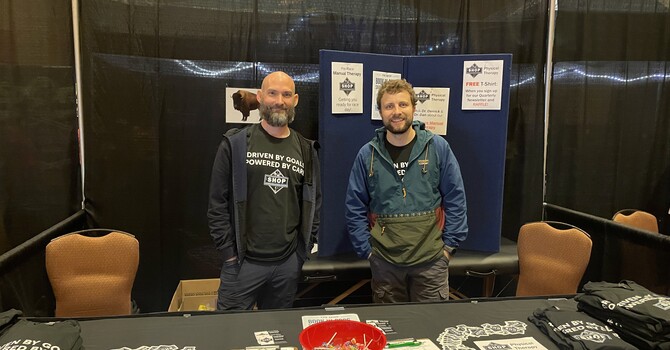
At The SHOP, not only do we have training backgrounds, but we are also Doctors of Physical Therapy. We understand movement, how movement is supposed to occur to prevent injury, and how to get the body to do what we want it to do without accommodation. The SHOP excels at finding the weaknesses in the sport or activity and turning those weaknesses into power, strength, stability, and excellence. We, at The SHOP, look forward to helping Springfield, MO and the surrounding areas meet their athletic, sport, and training goals. Driven by Goals. Powered by Care.
See you soon!
References:
1. Vladimir Mihajlovič Zaciorskij, Kraemer WJ. Science and Practice of Strength Training. 2nded. Human Kinetics, Cop; 2006.
2. Simmons L. Special Strength Development for All Sports. Westside Barbell; 2015.